


How to Improve Yoga Balance Faster
Balance gets exposed fast in yoga. One second you feel steady, the next your standing leg is shaking, your foot is gripping the mat for dear life, and your focus is gone. If you’ve been wondering how to improve yoga balance, the answer is not just to “try harder” or force yourself to hold poses longer. Better balance comes from training your body and your attention at the same time.
That’s the part people miss. Balance is strength, yes, but it’s also breath, alignment, coordination, and the ability to stay calm when you feel a little off-center. You do not need to be naturally graceful to get better at it. You need a smarter approach.
How to improve yoga balance starts with your foundation
Most balance problems start lower than you think. Before you blame your core, look at your standing foot and ankle. If your toes are clawing the floor or your weight is dumping into one side of the foot, the rest of the pose has to compensate.
In standing balance poses, press evenly through the ball of the big toe, the ball of the little toe, and the center of the heel. That tripod base matters. It gives you a grounded platform instead of a wobbly one. Then lift the arch gently rather than collapsing inward. This creates more activity through the foot and leg without making you stiff.
Your ankle also needs to respond quickly to tiny shifts. That kind of stability is trainable. Slow transitions, barefoot strength work, and simply pausing in single-leg shapes for a few breaths can build it over time. If your balance feels inconsistent from day to day, your foundation is often the first place to clean things up.
Stop rushing into the pose
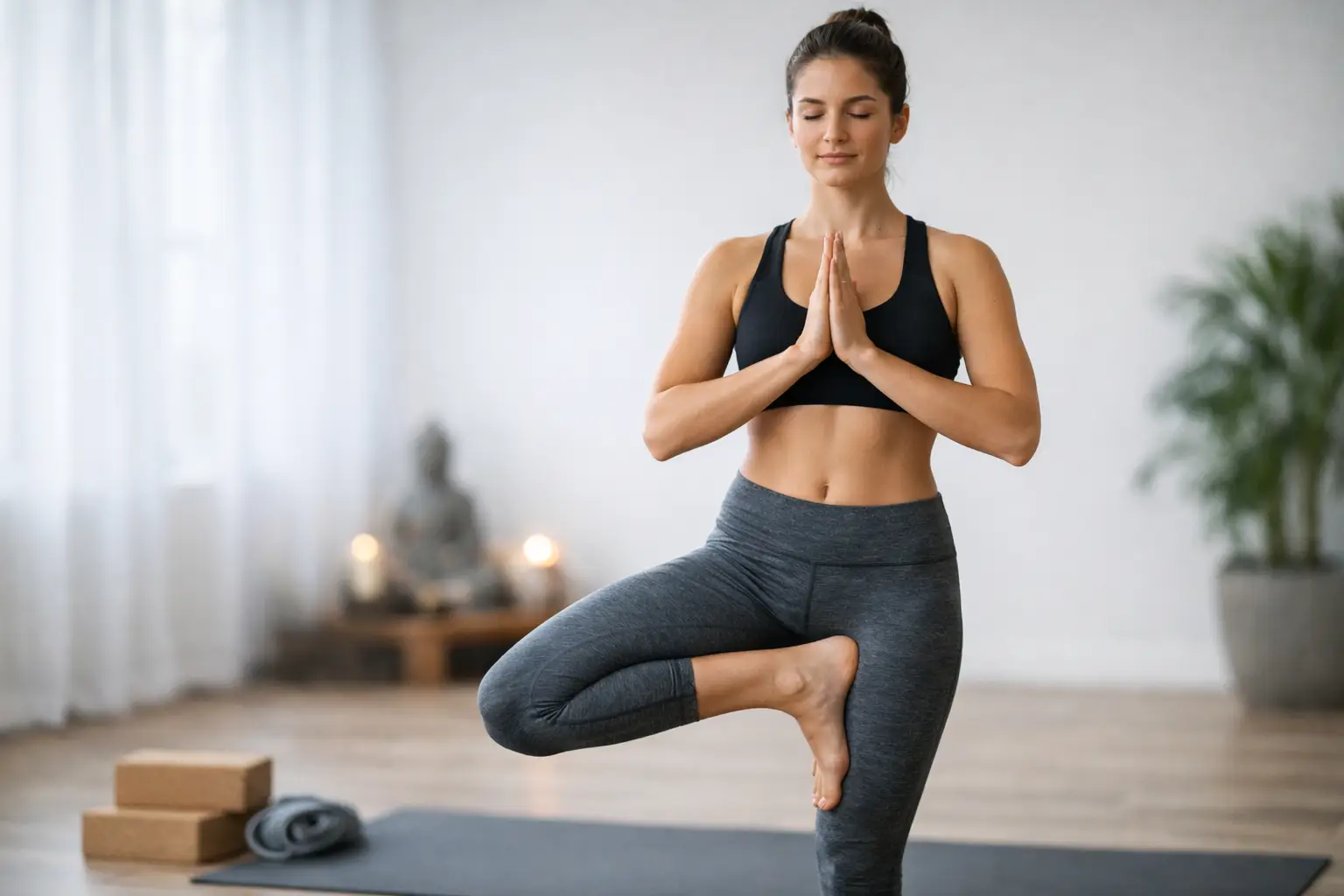
A lot of wobbling happens before the pose even begins. You step into Tree Pose fast, throw the foot up, and hope for the best. That usually turns balance into a fight.
Instead, treat the entry like part of the pose. Root through the standing leg first. Stack your ribs over your hips. Find one steady gaze point. Then move the lifted leg into place without letting the pelvis swing out or the standing hip lock back. It is less dramatic, more controlled, and much more effective.
This is especially true in poses like Dancer, Half Moon, and Warrior III. If your setup is loose, the shape will feel unstable no matter how strong you are. Precision is not extra. It is the work.
Your standing leg should be active, not frozen
There’s a difference between stability and rigidity. When people panic in balance poses, they often jam the standing knee straight and grip the glutes hard. That can actually make balance worse because the body loses its ability to make small, fluid corrections.
Think of the standing leg as alive. Lift through the thigh, engage the glutes and outer hip, and keep a soft responsiveness in the knee. You want muscular support without locking yourself into a statue.
Core strength matters, but not in the way people think
Yes, your core helps with balance. But this is not about crunch strength or chasing a flat stomach. In yoga, balance depends more on deep core support that keeps your spine and pelvis organized while the limbs move.
If your ribs flare, your low back overarches, or your pelvis tips forward every time you lift a leg, your center is not doing enough to stabilize you. That’s why standing balances can feel harder than they look. The body is negotiating a lot behind the scenes.
To build the kind of core control that transfers to yoga, focus on slow, intentional work. Pilates-based exercises, dead bugs, bird dogs, forearm planks, and controlled roll-down variations can all help. So can yoga shapes that demand anti-rotation, like side plank or a slow hover from tabletop.
The goal is not to brace so hard you stop breathing. The goal is to feel connected through your middle so your limbs can move with more control.
Use your breath to steady your body
If you hold your breath in balance poses, your body usually gets tighter and less coordinated. Breath is one of the fastest ways to change the quality of a pose.
A steady inhale can help you lengthen and organize. A slow exhale can help you root and engage. When your breathing stays smooth, your nervous system gets the message that you are safe enough to stay present, even if the pose feels challenging.
This matters more than people expect. Balance is partly physical, but it is also neurological. The more threatened or rushed you feel, the harder it is to make subtle adjustments. Breath gives you access to control without forcing the pose.
If you tend to wobble, try this: set up the pose on an inhale, then hold it for two to four slow breaths instead of jumping out the second you feel movement. Wobbling does not mean failure. It often means your body is learning.
Train your eyes and your attention
Your gaze can either anchor you or scatter you. In yoga, drishti is not just a stylistic detail. It is a practical tool for balance.
Pick one non-moving point at eye level or slightly below. Do not keep checking the mirror, the instructor, or the person next to you. Every visual shift asks the body to reorient. That is useful in some contexts, but if you are trying to build confidence in balance, simplify the input.
Attention works the same way. If your mind is jumping ahead to how long you have left in the pose or whether you look awkward, you are less available to feel what is happening in your body. Bring it back to one cue at a time. Press the foot. Lift the waist. Soften the jaw. Breathe.
That kind of focus has a compounding effect. It builds body awareness and makes balance feel less chaotic.
How to improve yoga balance with strength beyond yoga
If balance poses always feel impossible, it may not be a yoga problem. It may be a strength problem. Strong glutes, hips, calves, and deep core muscles support the kind of joint control that balance demands.
This is where cross-training helps. Barre can improve lower-body endurance and postural control. Pilates can sharpen deep core strength and pelvic stability. Strength training can build the single-leg power you need for cleaner transitions and steadier holds. A well-rounded body handles yoga balance better.
That’s especially true for busy women who spend a lot of time sitting, carrying kids, standing on one hip, or moving through the day with more stress than recovery. Your body brings all of that into class. Smart strength work fills in the gaps.
If you’re taking yoga regularly and still feeling stuck, adding even one or two strength-focused sessions a week can make a real difference. Not because yoga is lacking, but because your body may need more support than flow alone can provide.
Practice the poses that challenge you – with modifications
There is a time to push and a time to scale. If you avoid balance poses because you feel shaky, improvement will be slow. But if you force full expressions every time, you may just rehearse bad patterns.
Use the wall, keep fingertips lightly on a block, or shorten the range of motion. In Half Moon, for example, a block under the bottom hand can change the entire experience. In Warrior III, keeping the back toes on the floor for a moment can help you understand the line of the pose before lifting fully.
Modifications are not a step back. They are often the fastest route to better mechanics. They let you train the shape without panic, and that is where progress lives.
Accept that balance changes day to day
Some days your balance is sharp. Other days it is not. That can be because of sleep, hormones, stress, hydration, what shoes you wore all day, how hard you trained yesterday, or how mentally scattered you feel walking into class.
This is where frustration can derail people. They assume a shaky day means they are not improving. Not true. Balance is sensitive. It reflects your whole system, not just your effort.
A better mindset is to look for trends, not perfection. Are you recovering faster when you wobble? Are you entering poses with more control? Can you stay calm instead of immediately stepping out? Those are real signs of progress.
If you practice in a strong, supportive environment, you start to see balance differently. It stops being a test of elegance and becomes a skill you build with purpose, rep by rep, breath by breath.
The fastest way to get better
Practice balance more often, but not always at your hardest edge. A few focused minutes done consistently will do more than one heroic attempt a week. Start with simple single-leg holds, clean up your alignment, strengthen your core and hips, and stay with the breath when the pose starts talking back.
That’s how to improve yoga balance in a way that actually lasts. Not by chasing stillness, but by building a body and mind that can handle movement, challenge, and a little wobble without falling apart.
Strong balance has a certain energy. It is not stiff. It is not perfect. It is grounded, responsive, and fully awake. Bring that into your practice, and the pose starts meeting you halfway.